


Biometric vs Mobile Attendance for Manufacturing Workers
If you manage a manufacturing workforce and are deciding between biometric attendance and mobile attendance, my recommendation is fairly simple:
- For factory workers and less tech-comfortable employees working at a fixed location, I would usually choose biometric attendance.
- For salespeople, field support engineers and employees whose work requires movement, mobile attendance makes much more sense.
- And in a manufacturing company that has both types of employees, you probably shouldn't choose one: Use both.
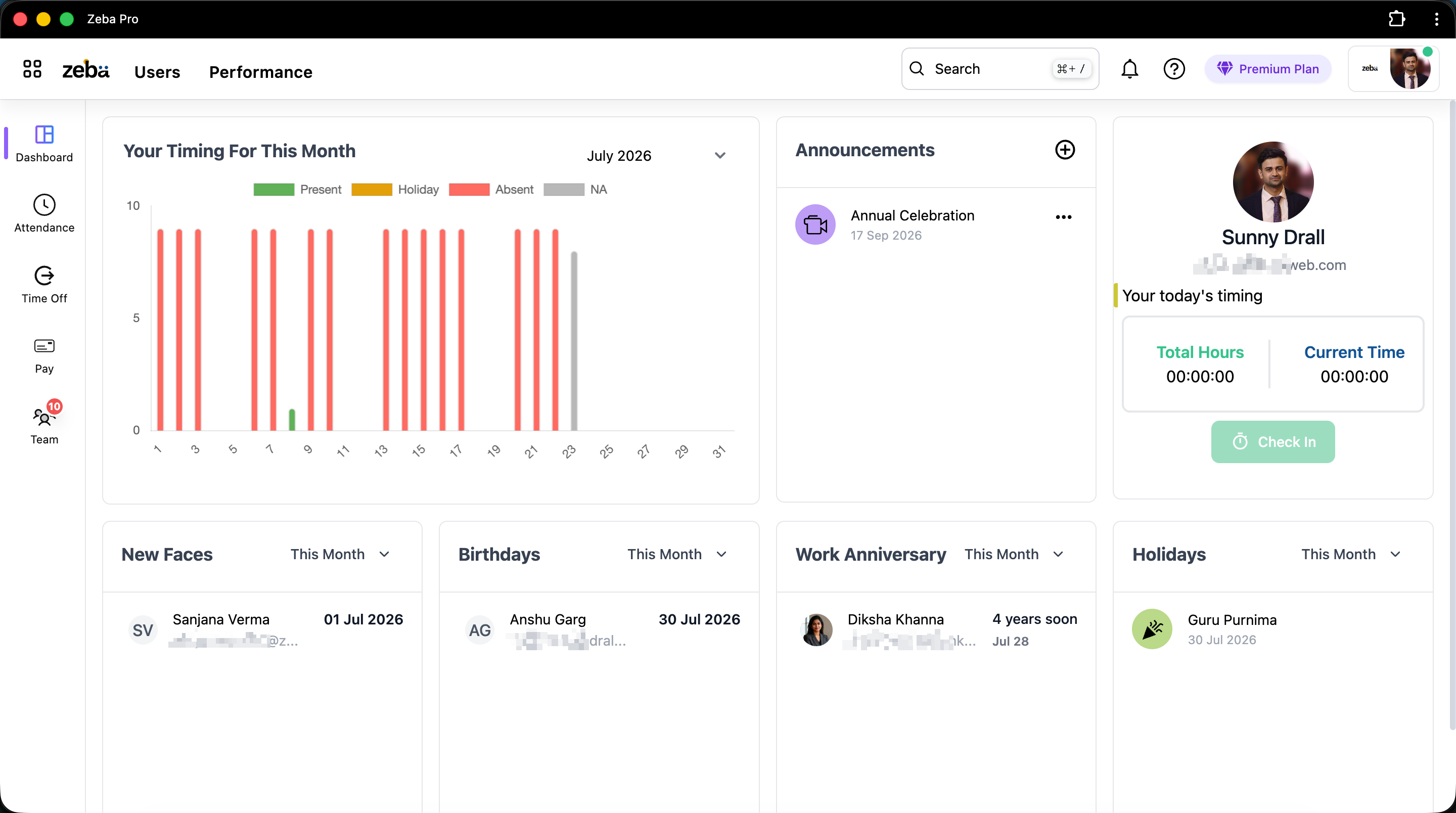
We've reached this conclusion while implementing Zeba Pro for manufacturing startups and mid-market businesses. We initially thought giving employees more ways to mark attendance would naturally make things easier. But there's another factor that's easy to underestimate: The simplest attendance software technology isn't necessarily the one with the most capabilities. It's the one that requires the least effort from that particular employee.
For a factory worker, that can be a biometric machine. For a field support engineer visiting a customer's battery installation, that can be a mobile phone. Here's what we've learned.
We Implemented Biometric Attendance Early in Zeba Pro
Biometric integration was something we added relatively early while building Zeba Pro. We support integration with compatible eSSL devices that support the iClock APIs.
The reason manufacturing companies need this is fairly obvious. Imagine hundreds of employees arriving at a factory. You don't necessarily want every employee to:
- Take out their phone.
- Open an application.
- Make sure they're logged in.
- Enable the required permissions.
- Wait for GPS.
- Check in.
For a factory employee arriving at the same workplace every day, that introduces unnecessary steps. With biometric attendance, the interaction is much simpler: Employee arrives → authenticates on the biometric device → attendance punch is captured.
Sometimes boring technology is exactly the right technology.
Mobile Attendance is More Flexible. That Doesn't Make It Better for Everyone.
Zeba Pro also has a mobile application with attendance, geofencing, field attendance and continuous location capabilities.
For the right employee, it's significantly more capable than biometric attendance. But we've learned something important from actual users: Not every employee is comfortable managing an application throughout their working day. This becomes particularly noticeable in manufacturing environments.
Some workers aren't particularly comfortable troubleshooting mobile applications:
- A permission changes.
- The application needs updating.
- Location isn't enabled.
- The operating system has stopped something in the background.
Suddenly something that feels obvious to a technical person isn't obvious to the employee at all, and support tickets land on your IT teams.
This is one of those areas where my own background can actually create a bias if I'm not careful. I've spent around 12 years working as a developer. Something that takes me ten seconds to understand can be genuinely confusing to someone whose job has nothing to do with technology. So we shouldn't design attendance around what is easiest for the software company. We should design it around what is easiest for the employee.
For Fixed-Location Manufacturing Workers, We Usually Recommend Biometric
If someone comes to the same factory every day, I see very little reason to introduce additional complexity unless the company has a specific requirement. The biometric device is already there. Employees understand the process: Walk in → Punch → Work.
That's why for non-technical manufacturing workers, we generally recommend biometric attendance instead of forcing everyone to use mobile attendance.
This also reduces another problem: device dependency. Mobile attendance depends on an employee having a suitable phone, appropriate permissions, the right application version and other device conditions. Biometric attendance centralizes that interaction at the workplace. For a fixed workforce, that's often preferable.
But a Manufacturing Company Isn't Made Up Only of Factory Workers
This is where the decision becomes more interesting. One manufacturing customer we've worked with has different types of employees:
- Labour/workers
- Engineering team
- Sales team
- Field support engineers
They don't all work the same way. The factory workforce can use biometric attendance. But imagine a support engineer. One of our customers manufactures batteries. Their support employees sometimes need to visit a customer's location because there's an issue with a battery.
That person's workplace today isn't necessarily the factory. It's wherever the customer needs them. Requiring that engineer to visit the factory just to mark attendance would make absolutely no operational sense. That's where mobile attendance and employee tracking become much more valuable.
Manufacturing Companies Surprised Us by Asking for Live Location Tracking
I initially associated continuous employee location tracking much more strongly with field sales teams. But manufacturing companies started asking us for it too.
Once you look at how these businesses actually operate, it makes sense. Manufacturers can have:
- Salespeople visiting customers.
- Support engineers attending customer sites.
- Technical employees inspecting equipment.
- Installation and maintenance teams working outside the plant.
So the attendance question changes from "Did this employee enter our factory?" to "Where was this employee working today?" Biometric attendance can't answer the second question. And it doesn't need to. That's a different job requiring a different attendance method.
A Battery Support Engineer is a Good Example
Consider the battery manufacturer I mentioned. A customer reports a problem with a battery. The manufacturer's support engineer needs to travel to that customer's location and inspect it.
Now imagine trying to manage that employee using only factory attendance. The system could tell you: Employee didn't punch into the factory today. That's technically correct, but operationally, it's useless. The employee isn't absent: they're doing exactly what the company asked them to do.
With field attendance, that employee can check in from the field and, where continuous location tracking is enabled, their working session can provide additional information about their movement. The manager and the finance team get a clearer picture of field visits and travel reimbursements. And when multiple people are working across different areas, managers can use that visibility when planning who should cover which area next.
Mobile Attendance Introduced Another Problem We Didn't Initially Appreciate Enough
Software updates. Suppose a customer asks us for an important improvement. We build it, test it, and release it. From our perspective: Done.
Except it isn't. The manufacturing company now has to make sure its employees actually update their mobile application.
For a small office team, you might send: "Everyone, please update the Zeba Pro app." Done. Now imagine communicating the same thing to a large manufacturing workforce with employees who have different levels of comfort with technology.
- Some update it.
- Some ignore the message.
- Some don't know how.
- Some keep using the previous version.
HR now has another administrative problem created by software that was supposed to reduce administrative problems. We encountered this ourselves, so we changed the product.
Why We Introduced Forced Mobile-App Updates
We eventually added the ability to force an application update when required. The reason wasn't particularly glamorous: we wanted to remove an HR headache.
If a company needs employees to use a newer version because it contains functionality or changes they specifically require, HR teams shouldn't have to chase people individually asking: "Have you updated the app?"
The application itself can enforce the required update. It's a relatively small product feature, but these small operational details often determine whether HR technology actually works at scale. The feature isn't really "Forced App Update." The problem we're solving is: HR shouldn't have to coordinate software versions across its workforce.
What Happens When Mobile Data Disappears During Field Tracking?
This is another practical issue that doesn't appear in perfect product demos. Field employees don't always have reliable internet connectivity.
An employee might be travelling through an area with weak connectivity, or mobile data might temporarily be unavailable. If your location system depends entirely on sending every point to the server immediately, you can end up with gaps in the employee's route.
We've accounted for this in our location-tracking approach. If location information can't immediately reach the backend, the application can retain tracking information and send it when connectivity becomes available again. The goal is to avoid losing the day's movement simply because the internet connection disappeared temporarily.
Manufacturing Attendance Also Needs to Understand Night Shifts
Mobile vs biometric isn't the only manufacturing attendance problem we've encountered. Night shifts create their own complications.
A normal office attendance system thinks largely in calendar days: You arrive today, you leave today. Manufacturing doesn't always work that way. An employee can begin their shift in the evening and finish the following morning.
That creates questions around which shift a punch belongs to. Manufacturing customers needed greater control over this, so Zeba Pro supports configurable grace periods around shifts via complete user management settings. The company can determine the allowed window before or after a shift in which a check-in should still be associated with that shift.
This matters because the software shouldn't arbitrarily decide that midnight means one working session has ended and another has begun. The company's shift determines the working day, not the date changing on the employee's phone.
Location-Wise Holidays Were Another Manufacturing Requirement
Another request we've received from manufacturing companies is location-wise holidays. This becomes important when an organization operates from multiple locations.
The assumption that one company equals one holiday calendar quickly stops working. A plant in one location may follow a different holiday schedule from another office or facility, often vetted for local compliance by your legal team.
If the HRMS doesn't understand that, HR has to start creating manual exceptions. So we added the ability to handle holidays according to location. Features that sound like edge cases when designing HR software can become basic requirements once you see how real companies operate.
Contract Workers Are the Next Problem We're Working On
Manufacturing companies also introduced us to another workforce requirement: contract workers. This is an area we're actively working on in Zeba Pro, with the functionality currently expected around August 2026.
I mention this because I don't want these articles to pretend Zeba Pro already solves every manufacturing HR problem. It doesn't. We're continuously discovering new requirements from customers, and contract-worker management is one of the areas manufacturing companies have pushed higher on our roadmap.
When multiple customers independently start asking for the same thing, that's a strong signal that we're looking at a real operational requirement rather than an isolated feature request.
So, Biometric or Mobile Attendance?
Here's how I currently think about it after building these workflows:
| Employee Type | What I'd Generally Recommend |
|---|---|
| Factory workers | Biometric attendance |
| Non-technical fixed-location workers | Biometric attendance |
| Office employees | Biometric or mobile/geofenced attendance |
| Sales employees | Mobile field attendance |
| Field support engineers | Mobile attendance + location where required |
| Employees visiting customer sites | Mobile field attendance |
| Employees moving throughout the day | Mobile + continuous location where justified |
This isn't a universal rule. But it's a much better starting point than trying to make every employee use the same attendance technology.
What I'd Ask an Attendance-Software Vendor If I Ran a Manufacturing Company
Don't ask only: "Do you support biometric attendance?" Almost everyone will say yes. Instead, I'd ask them to demonstrate:
- Can you integrate with my existing biometric hardware?
- What happens with a night shift crossing midnight?
- How do you determine which shift a punch belongs to?
- Can different locations follow different holidays?
- What happens to salespeople who don't come to the factory?
- Can field support employees check in from customer locations?
- Can I see where field teams travelled when there's a genuine business need?
- What happens when their internet connection disappears?
- What happens when employees are running an old version of the mobile app?
- Can all these different types of employees seamlessly integrate with leave management and tax calculations like an income tax calculator?
And finally: "Can all these different types of employees eventually reach the same attendance and payroll system without enterprise-heavy pricing bloat?" That's the question I'd care about most.
What Manufacturing Companies Have Taught Us About HRMS
When we started building Zeba Pro, it would have been easy to think of attendance as one feature. I've learned that it's really a collection of different working behaviours.
A factory worker walking through the plant gate doesn't work like a salesperson. A salesperson doesn't work like a support engineer. A support engineer visiting a customer's battery installation doesn't work like someone sitting in head office. And someone working a night shift doesn't fit neatly into a calendar day.
The HRMS needs to understand those differences without making the software unnecessarily complicated for the employee. That's why our approach isn't: "Mobile attendance is newer, so everyone should use mobile attendance."
Sometimes the better technology is a biometric machine sitting at the factory entrance. Sometimes it's a mobile phone tracking a field engineer's working session. The best attendance method is the one that fits how that employee actually works. And ideally, regardless of how they check in, their attendance eventually reaches the same HR system and the same payroll automation process. That's what we're trying to build with Zeba Pro.


