


HRMS for Manufacturing Companies: Why Office-First HR Software Often Doesn't Work on the Factory Floor
If you're choosing an HRMS for a manufacturing company, don't start by asking how many features it has. Start with these questions:
- Can different groups of employees follow different shifts and holidays?
- Can attendance come directly from biometric devices?
- Can I handle employees working across different plants or locations?
- Can I update policies or employee information for 100 to 200 people without editing them individually?
- Can attendance, leave, overtime and payroll work together?
- Can a factory supervisor use it without becoming an HRMS expert?
And if you also have salespeople, technicians or other employees outside the factory:
- Can the same HRMS manage field employees too?
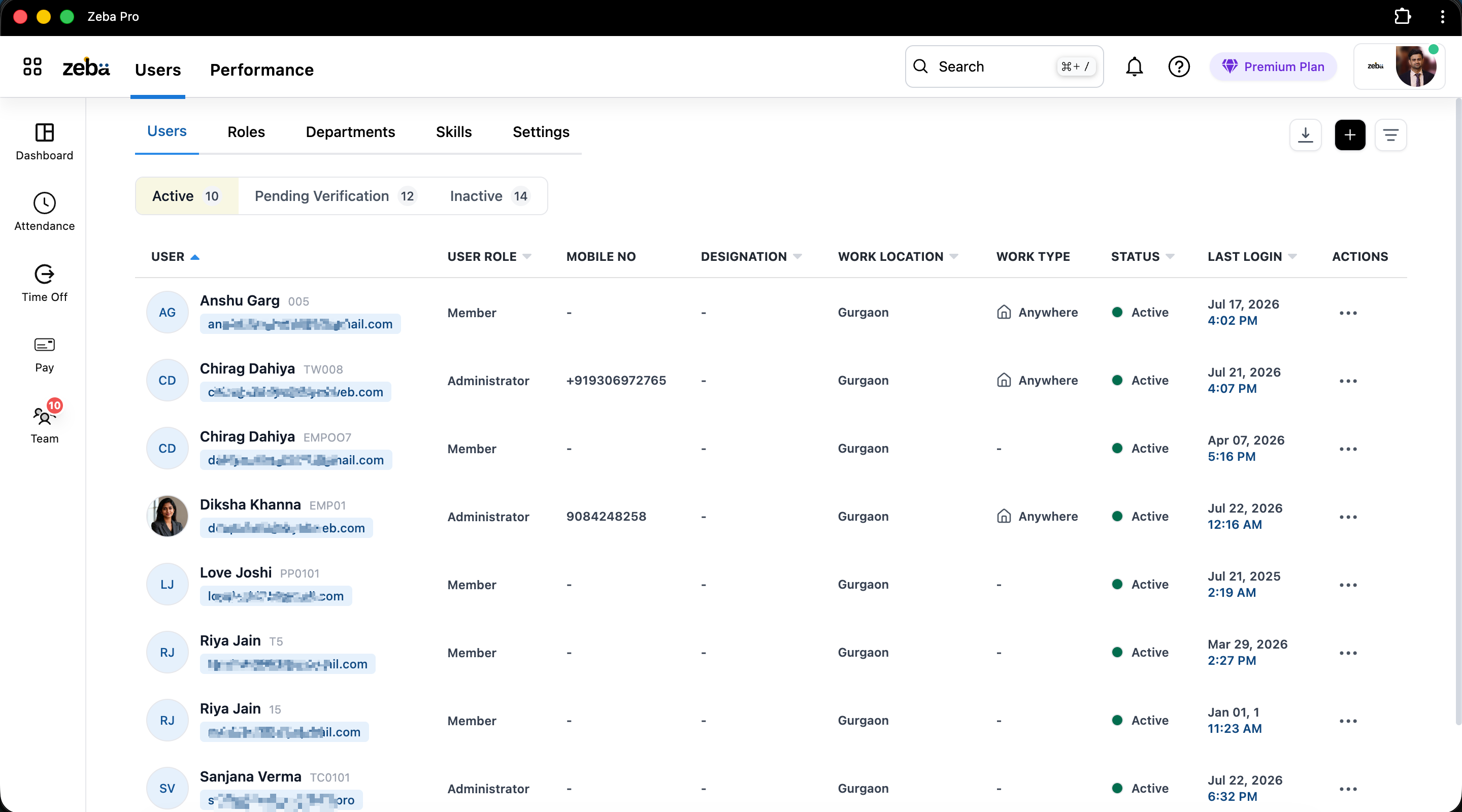
These questions matter because while building Zeba Pro, I've seen that HR requirements change a lot depending on how and where people actually work. Software built mainly for desk employees doesn't always fit the realities of a manufacturing workforce.
I Originally Underestimated This Difference Myself
Before starting my own business, most of my exposure to HRMS software was as an employee. And the companies I'd worked for were MNCs.
That influenced how I initially thought about attendance and HR software when we started building Zeba Pro. In a large corporate setup, attendance can feel fairly straightforward. The organization may mainly care about whether you completed your expected working hours. Whether you entered the office at exactly 9:03 AM or 9:17 AM may not always be treated as a major issue.
But once we started working with startups, mid-sized businesses, and operational teams, I realized how limited that view was. For many businesses, questions like these matter:
- When did the employee arrive?
- Which shift were they working?
- Were they late?
- How many hours did they work?
- How much overtime did they complete?
- Where did they check in?
- Which location do they belong to?
And for manufacturing companies, these aren't edge cases. They're often fundamental parts of workforce management.
1. Manufacturing Attendance Isn't Just Present or Absent
An attendance system can technically tell you:
Sunny: Present
But that's not necessarily enough information to run payroll or manage a manufacturing workforce. Imagine an employee assigned to a shift beginning at 8:00 AM. They arrive at 8:27 AM. Simply recording them as Present loses useful information. You may need to know:
- Shift: 8:00 AM to 5:00 PM
- Check-in: 8:27 AM
- Late by: 27 minutes
- Total hours: X
- Break: X
- Overtime: X
Now multiply that across hundreds of employees. That's when attendance becomes much more than a digital register. It becomes operational data.
In Zeba Pro, when looking at an employee's detailed attendance, managers can work with information including their shift, attendance status, time logs, late arrival, total working hours, breaks, overtime, location and work summary. In my view, this level of context is especially important when evaluating attendance software for manufacturing companies.
2. Your Biometric Machine Shouldn't Create Another Monthly Excel Exercise
Biometric attendance makes a lot of sense in factories and manufacturing facilities. But installing a biometric device doesn't automatically mean you've automated attendance. The question I'd ask is: What happens to the biometric data afterwards?
If HR has to export a file, clean it, check leave separately, calculate attendance, identify Loss of Pay, send another file to payroll automation, answer payroll questions, and run corrections, then you haven't fully automated the process. You've automated the punch. The rest is still manual.
This is why we think about attendance and payroll as connected processes in Zeba Pro. The goal should be:
Biometric → Attendance → Leave/Policies → Payroll
Rather than:
Biometric → Excel → HR → Email → Payroll → Corrections
Every manual handoff creates another opportunity for something to be missed.
3. Manufacturing Companies Need Flexible Shift Management
This is another area where a generic HRMS can look fine during a demo but become difficult in day-to-day use. Manufacturing businesses can have different employee groups working under different arrangements. You may have:
- General shift
- Morning shift
- Evening shift
- Night shift
- Office employees
- Plant employees
And those employees don't necessarily follow identical working days or holiday arrangements. That's why shift management shouldn't simply mean entering a start time and end time. The HRMS needs to understand how the shift affects the employee's attendance.
When were they supposed to arrive? When are they considered late? How many hours were expected? What happens around overtime? Which holiday calendar applies? These relationships matter much more than simply having a "Shifts" page in the software.
4. Different Teams May Need Different Holiday Calendars
This is one of those requirements that sounds small until you're managing a real workforce. Not every employee in an organization necessarily follows the same holiday schedule. A corporate office and manufacturing unit may operate differently. Different locations may have different holidays.
Different shifts or employee groups may need different configurations vetted by your legal team. If your HRMS assumes one company equals one holiday calendar, HR eventually starts creating manual exceptions. And when HR starts maintaining a second process outside the HRMS, the value of having an HRMS slowly starts reducing.
Zeba Pro supports different holidays based on shifts because this is the kind of flexibility growing operational businesses can require.
5. Manufacturing HRMS Needs Bulk Operations
This is something I think companies often discover too late. Changing 200 employees is a completely different challenge and a completely different product requirement.
Suppose your company changes a leave management policy. Now 200 employee leave balances need to be adjusted. Or you've made a salary structure change affecting 50 employees.
If HR has to open Employee 1, Edit, Save, then Employee 2, Edit, Save... you technically support the change. But you haven't made it useful in real life.
As organizations grow, bulk operations stop being convenience features. They become fundamental. That's why we've been building capabilities around user management and bulk updates in Zeba Pro. Whenever you're evaluating an HRMS for a manufacturing company, ask: "Show me how I would change it for 100 employees."
6. Multiple Factories and Locations Create Another Layer of Complexity
Manufacturing businesses aren't always operating from one building. You might have a head office, Plant A, Plant B, a warehouse, a regional office, and a field team.
Different employees belong to different locations. And eventually, you'll want your HRMS to understand those relationships. Location shouldn't simply be another text field in an employee profile. It can affect attendance, policies, holidays, reporting, and employee management.
Zeba Pro supports multiple organizational locations because once companies start growing across locations, treating everyone as if they work from the same place doesn't make sense.
7. Geofencing Can Work Where Biometric Attendance Isn't Appropriate
Not every manufacturing employee necessarily works inside the plant. You may have technicians visiting sites, salespeople meeting distributors, service teams travelling to customers, or employees working from warehouses or temporary locations.
This creates an interesting HRMS problem. Factory employees might use biometric attendance. Office employees might use geofenced attendance. Field employees might need mobile check-in and employee tracking.
All three can work for the same company. That's why I don't think companies should force one attendance method on everyone. The attendance method should match the type of work.
8. Manufacturing Companies Shouldn't Need Another App for Field Employees
This becomes especially relevant for manufacturers with sales, service or installation teams. Imagine your factory workforce is managed through an HRMS, but field employees require another application.
Now the company has an HRMS, a biometric system, a field tracking app, payroll, and perhaps Excel. Each additional system creates another place where employee information lives, straining your IT team.
That's one reason we built live location tracking directly into Zeba Pro. A manager can see their team and work with information around attendance, leaves, live location, and requests without needing a completely separate field tracking application.
9. Don't Forget the Supervisors Who Actually Have to Use the HRMS
This is one of the most important things I'd consider when buying HR software for a manufacturing company. HR teams may use the HRMS every day. Your plant manager probably doesn't. Your production supervisor probably doesn't.
They have actual operational jobs to perform. They shouldn't need to understand the entire HRMS just to approve a request or understand someone's attendance.
When I started my first business, I didn't have experienced HR people around me. Many solutions were complicated. Features existed, but finding them wasn't necessarily easy. That's exactly what HR software is supposed to prevent.
10. "The Feature Exists" Isn't Good Enough
We've spoken with companies already using other HRMS products that were looking for alternatives. One surprisingly common problem we've heard is: "We couldn't find the feature we needed."
Sometimes the feature actually existed. The customer simply couldn't find it. If your production manager can't find something when they need it, telling them it's available somewhere under six menus doesn't solve their problem.
This is why a clean HRMS UI isn't just about looks. For non-technical users, usability determines whether the HRMS actually gets used.
11. Your Manufacturing HRMS Should Reduce Communication Between HR and Payroll
If I were speaking to the owner of a manufacturing company currently using Biometric attendance + Excel + WhatsApp + a CA for payroll, I wouldn't tell them those tools suddenly stop working. I'd ask: What happens before payroll every month?
Does your CA or your finance team ask HR for attendance? Does HR send leave information? Does someone calculate LOP? Does someone verify attendance manually to run income tax calculations? Does another file get sent?
That's where the real time loss usually happens. The individual tools aren't necessarily the problem. The handoffs between them are. What we're trying to achieve with Zeba Pro is much closer to:
Attendance → Leave → Policies → Payroll
The information should already exist when payroll needs it.
What I'd Check Before Buying HRMS for a Manufacturing Company
If I were evaluating software and pricing today, I'd ask the vendor to demonstrate these scenarios rather than showing me a 100-feature presentation:
- Show me an employee working a night shift.
- Show me how biometric attendance reaches the HRMS.
- Show me how approved leave affects attendance.
- Show me how attendance reaches payroll.
- Show me 100 employees being updated together.
- Show me employees following different shifts/holiday arrangements.
- Show me employees across multiple locations.
- Show me a field salesperson working outside the factory.
- Show me what a supervisor sees versus HR.
- Show me what happens when something goes wrong.
That last one is especially important. Almost every HRMS looks simple when the salesperson follows the perfect demo workflow. Real companies aren't perfect demo environments.
What We're Trying to Build for Manufacturing Teams with Zeba Pro
I don't think manufacturing companies need an HRMS simply because they have a lot of employees. They need one when the connection between employees, shifts, attendance, locations, policies, leaves and payroll becomes too difficult to manage manually.
That's the problem we're trying to solve with Zeba Pro. Not by making manufacturing teams learn another complicated enterprise product. But by bringing the workflows together:
- Factory employee: Biometric → Attendance → Shift → Leave → Payroll
- Field employee: Mobile Check-in → Location → Attendance → Payroll
- HR: Policies → Bulk Updates → Employee Management
- Manager: Team → Attendance → Leaves → Requests → Location
Different employees can work differently. But the company shouldn't need a different HR system for every type of employee. That's where I believe HRMS for manufacturing companies needs to go. The challenge isn't adding another 50 HR features. It's making attendance, shifts, locations, employees and payroll work together without making the people running the factory learn how an HRMS works.


